Freezer not cold enough
This step-by-step repair guide walks you through fixing freezer not cold enough on your GE GFE28GYNFS (French Door). With the right tools and parts, most homeowners can complete this repair in 1–2 hours and avoid a costly service call.
🔨 Pro Tip from Dave
On the GFE28GYNFS, don’t overlook the defrost thermostat (WR50X10068) — techs often replace the heater and call it done, only to get a callback weeks later because the thermostat was the real failure all along. Also, when you pull the evaporator cover, watch for a small drain tube clip that snaps off easily and causes water pooling issues if you force it.
Part of our Top 20 Refrigerator Models & Common Repair Issues Guide. Browse all refrigerator repair guides for related models and issues.
“`html
Common Symptoms & Causes
If your GE GFE28GYNFS freezer isn’t maintaining proper temperature, you may notice one or more of the following warning signs.
- Freezer temperature reads warmer than the set 0°F even after several hours
- Ice cream is soft or partially melted inside the freezer compartment
- The freezer fan runs but frost buildup is visible on the evaporator coils
- Food in the freezer develops freezer burn or thaws unexpectedly overnight
These issues are most commonly caused by a failed evaporator fan motor, a faulty defrost heater, or a worn door gasket allowing warm air to enter the freezer compartment.
“`
Safety First
- Unplug the refrigerator from the power outlet before starting any repair — never work on a live appliance.
- Shut off the water supply valve before disconnecting any water lines or hoses.
- Wear work gloves when handling metal brackets, sheet metal edges, or sharp components.
- Take photos with your phone before disconnecting any wiring harnesses or connectors.
- Work in a well-lit area with enough floor space to lay removed panels flat.
Tools & Parts Needed
Essential Tools
- Phillips #2 screwdriver
- ¼” nut driver
- Needle-nose pliers
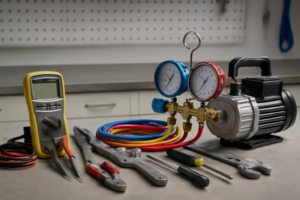
- Multimeter
- Flashlight or work light
Replacement Parts
- Defrost heater
- evaporator fan motor
- thermistor sensor
- multimeter
- thermometer probe
Step-by-Step Repair Instructions
Step 1
Place a thermometer probe in the center of the freezer and leave it for at least 15 minutes; the target is 0°F, and any reading above 10°F confirms a meaningful cooling failure worth diagnosing further. This baseline rules out a faulty door seal or overpacking as the culprit before you start disassembling anything. Pro tip: a cheap digital probe thermometer gives faster, more accurate readings than a dial-type.
Step 2
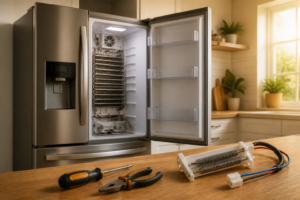
Unplug the unit before touching any internal components — the defrost heater circuit carries line voltage and must be de-energized. Remove the freezer back panel (4 Phillips #2 screws) to expose the evaporator coils, and look carefully at their condition: a thick layer of frost points to a defrost system failure, while completely bare, frost-free coils during a cooling complaint suggest a refrigerant leak that requires a certified technician. Either finding tells you exactly which direction to take the repair.
Step 3
With the coils accessible, disconnect the defrost heater and set your multimeter to Rx1 (resistance) to test it; a good heater will show continuity in the range printed on its label, typically 20–50Ω, while an open circuit reading means the heater has burned out and must be replaced. The defrost heater is the most common cause of frost-choked coils because when it fails, ice builds up unchecked over days until airflow through the coils is completely blocked. Safety note: confirm the unit is unplugged before probing — heater terminals sit close to the defrost thermostat and wiring that handles 120V during operation.
Step 4
Test the defrost thermostat — the small bi-metal clip fastened directly to the evaporator coil — by disconnecting it and checking for continuity with your multimeter at room temperature; it should show continuity when warm, and an open reading at room temperature means the thermostat has failed in the open position and is preventing the heater from ever energizing. This part is inexpensive and is the second most common defrost-circuit failure after the heater itself. Pro tip: if both the heater and thermostat test good, suspect the defrost control board or adaptive defrost timer as the next step.
Step 5
Spin the evaporator fan blade by hand to check for bearing wear; it should spin freely and smoothly, and any wobble, grinding resistance, or stiffness means the motor bearings are failing and restricting airflow across the coils. Reduced fan airflow will cause the freezer to under-cool even when the refrigeration and defrost systems are working perfectly. Replacement requires only removing 2 Phillips screws and unplugging the wiring harness clip — just note the blade orientation before pulling it so you reinstall it facing the correct direction.
Step 6
Reassemble the back panel, plug the unit back in, and allow at least 4 hours for the freezer to stabilize before rechecking the thermometer. If the temperature reaches 0°F, the repair is successful; if it remains above 10°F after a full cool-down cycle with a confirmed working defrost system and fan, the problem is insufficient refrigerant or a sealed-system issue that requires a licensed technician with recovery equipment. Pro tip: keep a log of the before and after temperatures so the technician has useful data if further diagnosis is needed.
Where to Buy Replacement Parts
Find genuine OEM and aftermarket replacement parts for your GE GFE28GYNFS (French Door) on Amazon:
- GE GFE28GYNFS defrost heater WR51X10055 replacement
- GE refrigerator evaporator fan motor WR60X10141
- GE refrigerator thermistor sensor WR55X10025
When to Call a Professional
If the issue persists after completing all steps above, the problem may involve the sealed refrigerant system, a failed main control board, or wiring that requires specialized diagnostic equipment. Contact a licensed appliance technician — attempting sealed-system repairs without EPA 608 certification is illegal and unsafe.
How Much Does This Repair Cost?
DIY parts for this repair — such as a condenser fan motor, evaporator fan, or thermistor — typically cost between $15 and $100 depending on the component. A professional service call for the same fix usually runs $150–$300 once you factor in labor. Tackling this repair yourself can save you $100 or more.
## Frequently Asked Questions
How long should I wait after adjusting the temperature settings before the freezer reaches the correct temperature?
Allow at least 24 hours for the freezer to stabilize after making any temperature adjustments. Avoid opening the door frequently during this period, as it slows the cooling process.
Could a dirty condenser coil cause my GE GFE28GYNFS freezer to not cool properly?
Yes, dust-clogged condenser coils force the compressor to work harder and reduce cooling efficiency. Clean the coils every 6–12 months using a vacuum or coil brush.
Is a faulty evaporator fan a common reason for insufficient freezer cooling on this model?
Yes, a failing evaporator fan prevents cold air from circulating throughout the freezer compartment. Listen for unusual noises near the fan or check for inconsistent temperatures as key warning signs.