Temperature fluctuations
This step-by-step repair guide walks you through fixing temperature fluctuations on your Samsung RF23M8070SR (French Door). With the right tools and parts, most homeowners can complete this repair in 1–2 hours and avoid a costly service call.
🔨 Pro Tip from Dave
On the RF23M8070SR, don’t overlook the dual evaporator setup — this model has separate cooling circuits for the fridge and freezer compartments, and a failed defrost heater assembly (part DA47-00244W) can cause the freezer to stay cold while the fridge fluctuates wildly. A common mistake I see is techs replacing the thermistor first without checking for ice buildup behind the evaporator cover, which is almost always the real root cause.
Part of our Top 20 Refrigerator Models & Common Repair Issues Guide. Browse all refrigerator repair guides for related models and issues.
“`html
Common Symptoms & Causes
If your Samsung RF23M8070SR is struggling to maintain consistent temperatures, watch for these telltale signs:
- Refrigerator compartment fluctuates between 42°F and 50°F instead of holding a steady 37°F
- Freezer section shows frost buildup along the back wall or around the evaporator cover
- The display panel reads an error code such as 88 88 or flashes “PC ER”
- Food spoils faster than expected despite the set temperature appearing correct on the panel
These issues are most commonly caused by a failing evaporator fan motor, a defective defrost sensor, or a worn door gasket allowing warm air infiltration over time.
“`
Safety First
- Unplug the refrigerator from the power outlet before starting any repair — never work on a live appliance.
- Shut off the water supply valve before disconnecting any water lines or hoses.
- Wear work gloves when handling metal brackets, sheet metal edges, or sharp components.
- Take photos with your phone before disconnecting any wiring harnesses or connectors.
- Work in a well-lit area with enough floor space to lay removed panels flat.
Tools & Parts Needed
Essential Tools
- Phillips #2 screwdriver
- ¼” nut driver
- Needle-nose pliers
- Multimeter
- Flashlight or work light
Replacement Parts
Step-by-Step Repair Instructions
Step 1
Place thermometer probes in both the fridge and freezer compartments and log temperatures every hour for at least 4–6 hours. You are establishing a baseline to confirm the problem is real and not a door-open spike — fluctuations greater than 5°F indicate an active mechanical or sensor failure worth diagnosing. Pro tip: use a dedicated digital thermometer rather than trusting the panel display, which reads from a single point and can mask zone-wide swings.
Step 2
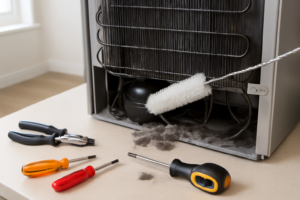
Remove the rear lower panel to access the condenser coils (4 × ¼” hex screws) and clean them by brushing top-to-bottom, then vacuuming loose debris. Restricted coils force the compressor to run longer and less efficiently, which is the single most common cause of temperature swings on this model. Safety note: unplug the refrigerator before removing the panel, and allow the compressor to cool for 5 minutes before working near it.
Step 3
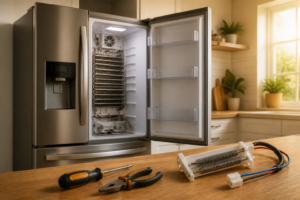
Remove the freezer back panel (5 × Phillips screws) to expose the evaporator fan, then spin the blade by hand to check for resistance or wobble. The evaporator fan circulates cold air through both compartments, so a worn bearing or failing motor creates uneven cooling and unpredictable temperature spikes. If the blade drags or the motor is noisy under power, replace the motor assembly — it is a direct plug-in swap on this model.
Step 4
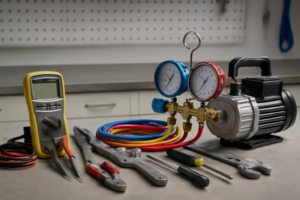
With the evaporator exposed, unclip the thermistor and test its resistance with a multimeter — at 32°F you should read approximately 5 kΩ; a reading significantly outside that range means the sensor is feeding the control board bad data. An out-of-spec thermistor causes the board to under- or over-cool because it cannot accurately judge compartment temperature. Pro tip: check the thermistor wiring harness for corrosion or pinched leads before condemning the sensor itself, as connector faults are common on this model.
Step 5
Test the defrost heater for continuity and the defrost thermostat for correct open/close behavior as outlined in the ice-freeze-over guide linked above. A failed defrost system allows ice to build up on the evaporator coil, progressively blocking airflow and causing the dramatic temperature spikes that appear hours after a defrost cycle should have run. If either component tests open when it should be closed, replace it before reassembling — running a partial system will not resolve the icing.
Step 6
Reassemble both panels, plug the refrigerator back in, and log temperatures in both compartments every hour for a full 24-hour cycle. You are verifying that the repair resolved the root cause across multiple compressor and defrost cycles, not just during the first hour of stable operation. Both zones should hold within ±2°F of their set points consistently; if swings persist, the issue is likely the main control board or a sealed-system refrigerant problem requiring a technician.
Where to Buy Replacement Parts
Find genuine OEM and aftermarket replacement parts for your Samsung RF23M8070SR (French Door) on Amazon:
- Samsung RF23M8070SR thermistor temperature sensor DA32-10105R
- Samsung refrigerator evaporator fan motor DA31-00146E
- Samsung refrigerator condenser cleaning brush kit
When to Call a Professional
If the issue persists after completing all steps above, the problem may involve the sealed refrigerant system, a failed main control board, or wiring that requires specialized diagnostic equipment. Contact a licensed appliance technician — attempting sealed-system repairs without EPA 608 certification is illegal and unsafe.
“`html
How Much Does This Repair Cost?
DIY parts for fixing temperature fluctuations on the Samsung RF23M8070SR typically run between $20–$150, depending on whether you need a thermistor, door gasket, or evaporator fan motor. A professional service call generally costs $150–$300 including labor and parts. Tackling this repair yourself can save you $100–$200 or more.
“`
Frequently Asked Questions
Why does my Samsung RF23M8070SR keep fluctuating between temperatures?
The most common cause is a faulty evaporator fan or a worn door gasket allowing warm air to enter. Inspect both components before assuming a refrigerant issue.
How do I know if the damper control is causing the temperature swings?
Listen for unusual clicking near the top of the fresh food compartment and check whether airflow feels inconsistent. A stuck or broken damper will prevent proper cold air distribution.
Can I fix temperature fluctuations on my RF23M8070SR without a technician?
Yes, many causes like dirty condenser coils or a failed door seal are straightforward DIY repairs. However, refrigerant leaks or control board failures require a certified technician.
Recommended Products
These are the parts and tools we recommend for this repair, based on compatibility and customer reviews:
- DA31-00287B DC12V Refrigerator Evaporator Fan Motor for Samsung Refrigerator Freezer Fan Motor Replacement Part Replaces DA96-00968A DA31-00334A PS9494284 3954921 AP5948644
- DA81-06013A Refrigerator Evaporator Fan Motor,Replacement Parts DA31-00287A U92C12MS1B3-52 for Samsung RF28HMEDBSR RF28HFEDTSR RF26HFENDSL RF25HMEDBSR etc,with Silent Sponge(No Noise)
- DA31-00287B Refrigerator Evaporator Fan Motor Replacement for Samsung Refrigerator Freezer Fan Motor Parts,Replaces DA96-00968A DA31-00334A 3954921 AP5948644 PS9494284 EAP9494284 Fridge Parts
- DA47-00244W Refrigerator Defrost Heater Assembly Compatible with Samsung Replaces PS9603659, AP5914487, 3955643
As an Amazon Associate, I earn from qualifying purchases.