Lid won’t lock
This step-by-step repair guide walks you through fixing lid won’t lock on your LG WT7300CW (Top Load). With the right tools and parts, most homeowners can complete this repair in 1–2 hours and avoid a costly service call.
🔨 Pro Tip from Dave
On the WT7300CW, the lid lock assembly (part number EBF61315401) is notorious for failing silently — meaning the part looks fine visually but the internal microswitch is dead. A common mistake I see DIYers make is replacing just the strike before testing the lock assembly itself with a multimeter; always check for continuity on the lock solenoid first or you’ll waste money on the wrong part.
Part of our Top 20 Washing machine Models & Common Repair Issues Guide. Browse all washing machine repair guides for related models and issues.
“`html
Common Symptoms & Causes
If your LG WT7300CW lid won’t lock, you’ll likely notice one or more of these telltale signs before or during a wash cycle.
- The washer displays an LE or dE error code on the control panel
- The wash cycle starts briefly then immediately stops or pauses
- You can hear the lid lock mechanism clicking repeatedly but the lid never engages
- The control panel shows “Lid Lock” indicator light flashing continuously
These issues are most commonly caused by a worn or failed lid lock assembly, a misaligned lid strike, or a faulty wiring harness connection between the lid lock and control board.
“`
Safety First
- Unplug the washing machine from the power outlet before starting any repair — never work on a live appliance.
- Shut off the water supply valve before disconnecting any water lines or hoses.
- Wear work gloves when handling metal brackets, sheet metal edges, or sharp components.
- Take photos with your phone before disconnecting any wiring harnesses or connectors.
- Work in a well-lit area with enough floor space to lay removed panels flat.
Tools & Parts Needed
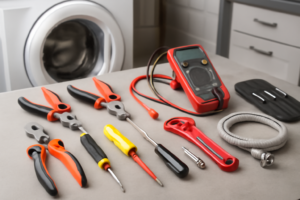
Essential Tools
- Phillips #2 screwdriver
- ¼” nut driver
- Torx T20 screwdriver
- Multimeter
- Bucket and towels
Replacement Parts
- Lid lock assembly
- lid hinge
- lid strike
- T20 Torx driver
- multimeter
Step-by-Step Repair Instructions
Step 1
Unplug the washer before doing anything — the lid lock is electrically activated and can shock you if power is live. Close the lid firmly and sight across both sides to confirm it sits flat with no visible gap; a warped or misaligned lid won’t depress the lock actuator, so the machine never receives the ‘lid closed’ signal and will refuse to start. If you see an uneven gap, the lid itself is the problem, not the lock.
Step 2
Locate the lid strike — the small plastic tab on the underside of the lid, toward the right rear — and inspect it for cracks or a clean break; this tab is what physically enters the lock assembly and triggers it, so a broken strike means the lock mechanism never engages regardless of how good the lock itself is. Replacement is straightforward: one screw holds the strike in place, and new strikes are inexpensive OEM parts. Pro tip: compare the broken strike to the new one before installing to confirm the tab geometry matches.
Step 3
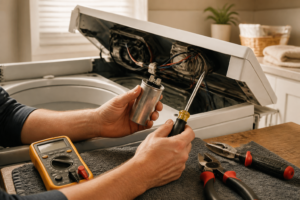
To reach the lid lock assembly, open the lid and slide a putty knife along the front underside of the top panel to release the two spring clips, then hinge the panel up from the rear — do not yank it, as the wiring harness is still attached. Unplug the lid lock harness connector, then set your multimeter to Rx1 and probe the solenoid terminals; a functional solenoid reads near zero ohms, while an open reading (OL) confirms the solenoid has failed internally. This test tells you definitively whether the lock is the cause before you spend money on parts.
Step 4
With the top panel raised, open and close the lid slowly and watch both hinges — if the lid drops faster on one side or feels loose and wobbly, the hinge pivot is worn and the lid is no longer traveling in a straight, consistent path into the lock. A misaligned lid caused by a bad hinge will cause intermittent or complete lock failures even when all other components are good. Replace the hinge assembly using the two bolts per side, and support the lid so it doesn’t fall while you work.
Step 5
If the solenoid tested open in Step 3, replace the lid lock assembly — slide the old unit off its mounting tab, disconnect any remaining connectors, then snap the new assembly into place and reconnect the harness. Make sure the harness clicks firmly; a loose connector will cause the same ‘dL’ error you started with and send you chasing a problem that isn’t there. Use only an OEM or OEM-equivalent lock rated for the WT7300CW, as aftermarket tolerances on the strike opening can vary.
Step 6
Plug the washer back in and run a normal wash cycle, pressing Start and watching the lid — the lock should engage with an audible click within three seconds of pressing Start, and the ‘dL’ error code should not reappear on the display. If the lock engages but ‘dL’ persists, unplug and reseat the harness connector one more time, as the control board needs a clean signal from the lock switch to clear the fault. A persistent ‘dL’ after a confirmed good lock and solid connection points to a control board issue.
Where to Buy Replacement Parts
Find genuine OEM and aftermarket replacement parts for your LG WT7300CW (Top Load) on Amazon:
- LG WT7300CW lid lock assembly ACQ85250601 replacement
- LG top load washer lid hinge replacement AEH72909601
- LG washer lid strike AEC37178801 replacement
When to Call a Professional
If the issue persists after completing all steps above, the problem may involve the sealed refrigerant system, a failed main control board, or wiring that requires specialized diagnostic equipment. Contact a licensed appliance technician — attempting sealed-system repairs without EPA 608 certification is illegal and unsafe.
“`html
How Much Does This Repair Cost?
Replacing the lid lock assembly on an LG WT7300CW typically costs $15–$45 in parts when doing it yourself. A professional service call for the same repair usually runs $150–$300 once you factor in labor and diagnostic fees. Tackling this repair DIY-style can save you over $100 while restoring your washer quickly.
“`
Frequently Asked Questions
Can I still run my LG WT7300CW if the lid won’t lock?
No, the washer won’t start a cycle if the lid lock fails, as it’s a built-in safety feature. You’ll need to resolve the issue before the machine will operate.
How do I know if the lid lock assembly needs to be replaced?
If you hear no clicking sound when closing the lid or see an error code like LE or dE, the lid lock assembly is likely faulty and should be replaced.
Is replacing the lid lock on the LG WT7300CW a DIY-friendly repair?
Yes, it’s a straightforward repair that requires basic tools and typically takes under 30 minutes. Always unplug the washer before starting any repair work.
Recommended Products
These are the parts and tools we recommend for this repair, based on compatibility and customer reviews:
- YIYANTO Upgrade Washer Lid Lock Switch Assembly Replacement for LG WT7300CW WT5270CW WT7200CW WT7150CW WT7100CW WT5070CW WT5001CW WT4870CW for Kenmore 79629002000 79629002010 Washing Machine
- Washer Lid Lock Switch Assembly Fit for LG WT7300CW WT5270CW WT7200CW WT7150CW WT7100CW WT5070CW WT5001CW WT4870CW WT4970CW WT7600HKA WT7005CW WT7800CW WT6105CW WT7900HBA WT7400CW WT5170HV
- FETIONS EBF61674802 Lid Lock Switch Assembly Replacement Fit for L-G & Ken-more Washer Replaces EBF60665201 AP5785599 PS8751171 AP8751171 2703681
- Washing Machine Lid Lock Switch Assembly for LG WT4870CW WT4970CW WT5001CW WT5070CW WT5101HV WT7200CV WT7100CW WT7500CW WT7600HWA WT5170HW WT5170WH WT7200CV 79631522210 79631522211 79631523210
As an Amazon Associate, I earn from qualifying purchases.