🔩 Door Hinge Repair Guide for LG LRG4115ST (Gas Range)
💡 This repair guide will be expanded with detailed instructions. Claude AI will add comprehensive explanations, safety tips, troubleshooting advice, and product recommendations.
🔨 Pro Tip from Dave
When replacing hinges on the LRG4115ST, don’t skip removing the door completely — trying to swap hinges with the door partially attached almost always leads to a stripped hinge slot or a cracked inner door panel. Also, part 4775DD3003A comes as a pair, so always replace both sides even if only one looks damaged; mismatched wear will have you back doing this job again in six months.
🔍 Symptoms
Door drops, won’t stay open
🔧 Part Numbers
- 4775DD3003A (pair)
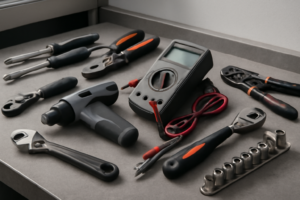
🔧 Required Tools
✔️ Difficulty & Cost
Difficulty: Moderate
Estimated Cost: $40-70
✔️ Repair Steps
Step 1: Open door fully
Open Door Fully
1. Stand directly in front of the range, positioning yourself centered with the oven door.
2. Grip the door handle with both hands, placing one hand on each end of the handle approximately 8-10 inches apart for balanced control.
3. Pull the door handle toward you with steady, even pressure until the door begins to swing open—you’ll feel resistance decrease after the first 2-3 inches of movement as the hinge mechanism releases.
4. Continue pulling the door open, guiding it smoothly through its arc until it reaches the fully open position at approximately 90 degrees from the closed position (the door will be horizontal, parallel to the floor).
5. Verify the door is fully open by checking that the bottom edge of the door is level with the floor and the door rests at a natural stop point—you should not need to hold it in place; the hinge mechanism holds it open on its own.
6. Look inside the oven cavity at the left and right sides where the door meets the range body—you’ll see two chrome or stainless steel hinge arms (one on each side) that are now fully extended and visible.
7. Inspect both hinge arms to confirm they are fully seated in the “open” position—the hinge arms should be straight and extend from the range body into the door frame without any bend or angle at the connection point.
Troubleshooting Tips for This Step
**If the door won’t open fully or stops partway:** – Check for obstructions on the floor directly beneath where the door opens—remove any floor mats, rugs, or debris within 24 inches of the range front. – Verify the range is level by placing a bubble level on the cooktop surface; if the range tilts forward, the door may not open to the full 90-degree position due to gravity pulling it closed. – Open the door more slowly with both hands maintaining equal pressure; uneven force can cause one hinge to bind.
**If the door feels loose or wobbly when fully open:** – This is normal wear but indicates the hinges may need replacement—document the amount of side-to-side play (movement) by grasping the door corners and measuring how far it moves (typically more than 1/4 inch indicates worn hinges). – Proceed with the repair, as this wobble confirms hinge replacement is needed.
**If one side of the door hangs lower than the other when open:** – One hinge is more worn than the other, but both should be replaced as a pair. – Continue with the repair process—do not attempt to adjust only one hinge.
**If the door closes on its own when you release it:** – The hinge springs are weak or broken—this confirms the need for hinge replacement. – You can temporarily prop the door open with a stable object (like a thick book) placed under the door’s bottom edge while you work, but remove this before proceeding to Step 2.
Step 2: Unlock hinge locks
Unlock Hinge Locks
1. Open the oven door fully to a 90-degree angle so it is horizontal and perpendicular to the front of the range.
2. Locate the two hinge locks on the left and right door hinges at the bottom corners of the oven opening where the door meets the range body.
3. Identify each hinge lock – they are small metal or plastic levers, approximately 1 inch long, positioned on top of each hinge arm, colored either silver (metal) or black (plastic).
4. Examine the current position of the hinge locks – in the locked position, the levers point toward the back of the range (away from you), lying flat against the hinge body.
5. Grip the left hinge lock lever between your thumb and index finger at its outer edge (the end furthest from the hinge pivot point).
6. Rotate the left hinge lock lever upward and forward (toward you) approximately 90 degrees until it stands vertically upright, perpendicular to the hinge body.
7. Release the lever – it should remain in the vertical unlocked position on its own without spring tension pulling it back.
8. Grip the right hinge lock lever between your thumb and index finger at its outer edge.
9. Rotate the right hinge lock lever upward and forward (toward you) approximately 90 degrees until it stands vertically upright, matching the left side.
10. Verify both hinge locks are in the unlocked position by visually confirming both levers are standing vertically upright, not lying flat against the hinge bodies.
Troubleshooting Tips for This Step
**If the hinge lock won’t rotate upward:** – The hinge lock may be corroded or stuck with grease buildup. Spray a small amount of penetrating oil (like WD-40) at the hinge lock pivot point, wait 2 minutes, then attempt rotation again. – Apply firm but steady pressure – the lever requires approximately 3-5 pounds of force to move if stiff from age.
**If the hinge lock snaps back down after you release it:** – This indicates the lock has an internal spring mechanism. Hold the lever in the upright position with one hand while proceeding to the next step, or wedge a small flathead screwdriver (1/4-inch width) between the lever and hinge body to hold it open.
**If the hinge lock breaks off during rotation:** – You can still remove the door, but you’ll need to order a replacement hinge assembly (LG part number 4775DD3002A for left hinge, 4775DD3001A for right hinge) before reinstalling. – Proceed with door removal by closing the door slightly to a 30-degree angle from vertical, then lifting straight up.
**What success looks like:** – Both hinge lock levers stand vertically at 90 degrees from their resting position, creating a clear visual indicator that the hinges are unlocked and ready for door removal.
Step 3: Close to 45-degree position
Close Door to 45-Degree Position
1. Grasp the oven door firmly with both hands—one hand on each side of the door at the outer edges, approximately 8 inches from the top.
2. Lift the door upward approximately 1 inch while simultaneously pulling it toward you to disengage it from the fully-open position. You’ll feel the hinge arms shift slightly as they release from the locked-back position.
3. Begin closing the door slowly, watching the hinge arms on both the left and right sides as they start to move forward through their track channels.
4. Stop closing the door when it reaches approximately 45 degrees from vertical. To verify this angle, the top edge of the door should be roughly 10-12 inches away from the front of the range when measured horizontally. The door will be angled significantly but not yet approaching horizontal.
5. Look at both hinge slots (left and right side) where the hinge arms enter the range body. The hinge levers should now be fully visible and accessible—you’ll see the curved metal lever on each hinge arm sitting approximately 2 inches outside the range frame.
6. Verify the door is stable at this position by releasing your grip slightly. The door should stay in place without falling closed or swinging open. If the door wants to fall closed, you haven’t lifted it enough in step 2 to release the hinge lock mechanism—repeat steps 2-4.
7. Confirm both hinge levers are now in the unlocked position. Each lever should be rotated downward (toward the floor) rather than upward (toward the door). This unlocked position allows the hinges to release from the range body in the next steps.
Troubleshooting Tips for This Step
**Problem: Door falls closed when you try to stop at 45 degrees** – The hinges are still locked in the fully-open position. Open the door fully again, lift upward more firmly (about 1.5-2 inches), then pull forward and close to 45 degrees.
**Problem: Door swings freely and won’t hold position** – This indicates damaged or worn hinge springs. You may need to support the door with one hand while working with the other during removal. Consider having a helper hold the door steady.
**Problem: One hinge lever is visible but the other isn’t** – The door isn’t evenly positioned. Open the door fully and repeat the process, ensuring you lift evenly with both hands before closing.
**Problem: Can’t see the hinge levers at all** – The door is closed too far (less than 45-degree angle). Open the door slightly until you can see 2 inches of each hinge arm protruding from the range frame slots.
**Problem: Door feels stuck or grinding when closing** – Check for debris in the hinge tracks on both sides. Wipe out any food particles or grease buildup from the U-shaped channels where the hinge arms slide.
Step 4: Lift door off hinges
Lift Door Off Hinges
1. Stand directly in front of the range with your feet shoulder-width apart for stability, as the door weighs approximately 15-20 pounds.
2. Grasp the door firmly with both hands—place your right hand on the right edge of the door at the midpoint (approximately 12 inches from the top) and your left hand on the left edge at the same height.
3. Lift the door straight upward approximately 2 inches until you feel the hinge arms disengage from the hinge slots in the frame. The hinges will slide vertically within their mounting channels.
4. Once lifted 2 inches, tilt the top of the door toward you at a 45-degree angle. This angle allows the hinge arms to clear the front lip of the hinge slots.
5. Continue pulling the door toward you while maintaining the 45-degree angle until the hinge arms completely separate from the range frame—you’ll feel the weight of the door transfer entirely to your hands as the hinges release.
6. Lower the door and lay it flat on a padded surface (folded towels or blankets on a table work well) with the exterior side facing down to protect the glass and finish.
7. Inspect the two hinge arms now visible on the bottom edge of the door. Each hinge arm is a metal piece approximately 8 inches long with a curved hook at the end—verify both are intact with no cracks or bends.
Troubleshooting Tips for This Step
**If the door won’t lift out after raising 2 inches:** – Verify the hinge locks are in the fully unlocked (downward) position from Step 3—each lock should be horizontal and flush with the hinge body. – Check that you’ve lifted the door the full 2 inches vertically; lifting only 1 inch will cause the hinge arms to catch on the slot edges. – Rock the door gently side-to-side while pulling upward to help the hinge arms release from any corrosion or debris in the slots.
**If the door feels stuck or bound when tilting:** – Stop tilting and lift the door an additional 1/2 inch higher before attempting the 45-degree tilt again. – Ensure you’re tilting from the top edge toward you, not pushing the bottom edge away, which can cause the hinges to bind.
**If one hinge releases but the other doesn’t:** – Lower the door back into position and restart from substep 2, ensuring you’re lifting straight up without twisting or angling the door to one side. – Apply equal lifting pressure on both sides—uneven lifting causes one hinge to bind while the other releases.
**If you drop the door during removal:** – The tempered glass may shatter—immediately stop and clear the area of glass fragments before continuing.
Step 5: Remove old hinges (2 screws each)
Remove Old Hinges (2 Screws Each)
1. Locate the two Phillips-head screws on the left hinge – one positioned at the top of the hinge bracket approximately 1 inch from the top edge, and one at the bottom approximately 1 inch from the bottom edge of the hinge mounting plate.
2. Insert your Phillips-head #2 screwdriver into the top screw of the left hinge and turn counterclockwise 8-10 full rotations until the screw is completely removed from the range frame.
3. Place the removed screw in your container immediately – these screws are approximately 3/4 inch long with a wide flat head and must not be mixed with other hardware.
4. Remove the bottom screw from the left hinge using the same counterclockwise rotation method, completing 8-10 full turns until the screw releases from the frame.
5. Grasp the left hinge bracket with your dominant hand and pull it straight forward away from the range frame – it will slide out approximately 1/2 inch before separating completely from the mounting surface.
6. Set the old left hinge aside on your work surface with the screws visible on top so you can compare hole alignment with the new hinge before installation.
7. Move to the right hinge and locate the identical two Phillips-head screws positioned in the same top and bottom locations as the left side.
8. Remove the top screw from the right hinge with 8-10 counterclockwise turns using your Phillips-head #2 screwdriver.
9. Remove the bottom screw from the right hinge with the same counterclockwise motion, placing both screws with the others in your container.
10. Pull the right hinge bracket straight forward away from the range frame until it separates completely from the mounting surface.
11. Inspect both hinge mounting areas on the range frame for rust, corrosion, or metal burrs that could prevent the new hinges from sitting flush – the mounting surface should be smooth and flat.
12. Use a clean dry cloth to wipe away any debris, grease buildup, or dust from the four screw holes (two on each side) – you should see clean metal threads inside each hole.
Troubleshooting Tips for This Step
**If a screw won’t turn:** The screw may be corroded or overtightened. Apply penetrating oil (WD-40 or similar) directly into the screw head groove, wait 5 minutes, then attempt removal again with firm downward pressure on the screwdriver to prevent stripping.
**If a screw head strips:** Use a screw extractor bit sized for #8 screws (typically a #2 extractor). Drill a small pilot hole in the center of the stripped screw head, insert the extractor bit, and turn counterclockwise to remove.
**If the hinge won’t pull free after screw removal:** Small amounts of rust may be bonding the hinge to the frame. Gently tap the hinge bracket with a rubber mallet on alternating sides while pulling forward – the hinge should break free after 2-3 light taps.
**If screw holes are damaged or stripped:** The new hinge screws will not hold properly. You must use slightly larger #10 sheet metal screws (instead of the original #8 size) to grip fresh metal in the enlarged holes.
Step 6: Install new hinges
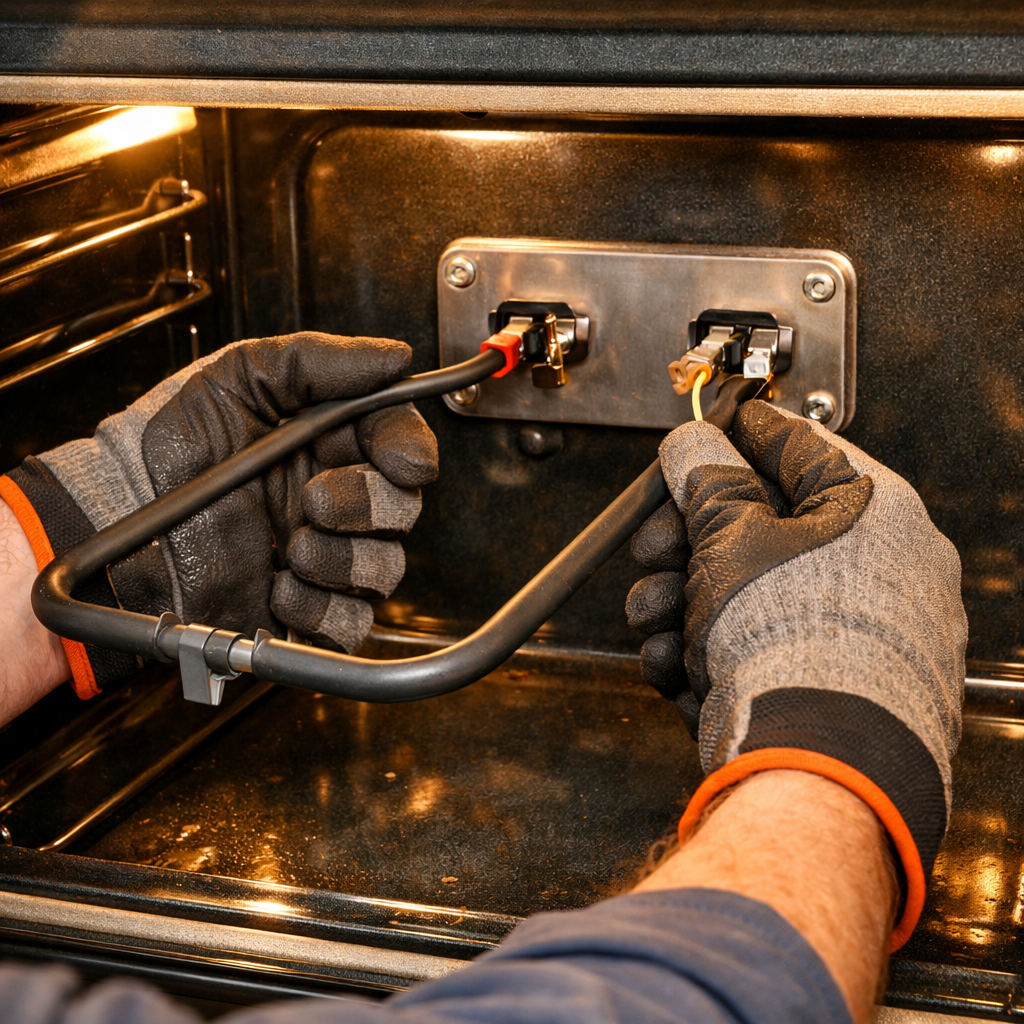
Install New Hinges
1. Remove the new hinge from its packaging and identify the left/right marking stamped on the metal bracket—look for an “L” or “R” on the top edge of the hinge arm.
2. Position the first hinge (starting with the left side) into the hinge slot at the bottom front corner of the oven cavity, inserting the bottom pin first at a 45-degree angle.
3. Rotate the hinge upward until the rectangular mounting plate sits flush against the oven frame—you’ll feel it seat into the recessed channel with a slight metallic scrape.
4. Align the two screw holes on the hinge mounting plate with the threaded holes in the oven frame, located 1.5 inches apart vertically.
5. Insert the top screw (included with the new hinge) into the upper hole and hand-tighten it 2-3 turns using your fingers—do not fully tighten yet.
6. Insert the bottom screw into the lower hole and hand-tighten it 2-3 turns.
7. Using a Phillips-head screwdriver #2, tighten the top screw in a clockwise direction until the hinge plate no longer moves when pushed—approximately 8-10 full turns, applying moderate pressure (about the force needed to open a jar).
8. Tighten the bottom screw the same way, ensuring the hinge mounting plate remains flat against the frame without gaps.
9. Verify the hinge is secure by grasping the hinge arm and attempting to move it side-to-side—it should not wiggle or shift at the mounting point.
10. Check the hinge tension spring (the coiled spring visible on the hinge arm)—it should be compressed against the hinge bracket, not loose or hanging.
11. Repeat steps 2-10 for the right hinge on the opposite side of the oven cavity.
12. Test both hinges by rotating each hinge arm upward to the fully open position (90 degrees from vertical)—they should move smoothly without binding or squeaking.
Troubleshooting Tips for This Step
**If the hinge won’t seat into the slot:** The hinge is either reversed (left in right position or vice versa) or debris is blocking the channel. Remove the hinge, vacuum the slot with a crevice tool, and verify the L/R marking matches the side you’re working on.
**If screw holes don’t align:** The hinge isn’t fully seated in its channel. Remove both screws, press firmly on the hinge mounting plate while pushing the hinge downward into the slot, then reinsert screws.
**If the hinge feels loose after tightening:** The screws may be stripped. Check that you’re threading into metal, not into old screw holes. New hinges typically include self-tapping screws that create fresh threads—you should feel resistance as you tighten.
**If the hinge arm doesn’t rotate smoothly:** The tension spring may be incorrectly positioned. The spring’s hooked end must engage the notch on the hinge bracket (visible as a small indentation on the metal bracket). Unhook the spring, reposition it in the notch, and test rotation again.
**If one hinge sits higher than the other:** Measure from the oven bottom to the hinge pin—both should be exactly 1.25 inches. An uneven installation means one hinge isn’t fully seated in its channel.
Step 7: Replace door
Replace Door
1. Position yourself directly in front of the range with the door lying face-up on your work surface, hinges oriented toward you at the bottom edge.
2. Grasp the door firmly by both sides with your hands positioned 8-10 inches from the top corners for balanced weight distribution (door weighs approximately 25 pounds).
3. Lift the door to a 45-degree angle, aligning the two hinge arms (one on each side) with the two hinge slots located at the bottom front corners of the range frame.
4. Insert the left hinge arm first by positioning the curved bottom hook of the hinge arm into the corresponding slot on the left side of the range frame, pushing straight down until the hook engages fully (you’ll feel it drop into place with a slight thud).
5. Immediately insert the right hinge arm using the same method—push straight down into the right slot until both hinges are seated at the same depth in their respective slots.
6. Lower the door slowly to approximately 15 degrees from fully closed (nearly vertical position) to engage the hinge locking mechanisms.
7. Locate the hinge lock levers on both hinges—these are small metal tabs visible on the inside face of each hinge, positioned at the top front edge where the hinge meets the range frame.
8. Push each hinge lock lever downward and toward the range body simultaneously until both locks click into their locked position (the levers will sit flush against the hinge body when properly locked).
9. Open the door to 90 degrees and verify smooth operation by opening and closing three times—the door should move without binding, scraping sounds, or uneven movement on either side.
10. Close the door completely and inspect the gap around the perimeter—there should be an even 1/8-inch gap on both sides and across the top, with no visible light coming through at the bottom seal.
Troubleshooting Tips
**If the door won’t seat into the hinge slots**: The hinge arms may not be fully extended. Open the hinges to their maximum 90-degree position and verify the hinge locks from Step 6 of the previous section are still engaged in the unlocked position (levers rotated upward).
**If the door hangs crooked or one side is lower**: One hinge is not fully seated. Remove the door by reversing steps 1-8, then inspect both hinge slots for debris or bent metal. Clean the slots and verify both hinge arms are straight before reinstalling.
**If the door won’t close evenly or gaps are uneven**: The hinge locks may not be fully engaged. Open the door to 15 degrees and firmly push both hinge lock levers down until you hear distinct clicks on both sides.
**If the door feels loose or wobbly when opening**: The hinge arms are not fully inserted into the slots. Remove and reinstall the door, ensuring you hear and feel both hinges drop into place in step 4-5.
📝 Next Steps: This post will be expanded by Claude AI with:
- Detailed step-by-step instructions with explanations
- Safety warnings and precautions
- Tool recommendations and usage tips
- Troubleshooting common issues
- Product recommendations (repair kits, tools) from Amazon via Firecrawl
- Affiliate links integrated naturally into sentence form
🔧 Recommended Parts & Tools
You can find the replacement part you need, such as this AmzGod Door Hinges Brushed Nickel – 3 Pack Satin Nickel 3.5 Inch Rounded Inte…, on Amazon. For this repair, you’ll need a Screw It Again EMW5953260, 10 Count which includes all the necessary components. You can find the replacement part you need, such as this MOOTVGOO 4 Pack 4581DD3003B Dishwasher Lower Rack Wheels, Bottom Dishrack Rol…, on Amazon. You can find the replacement part you need, such as this MEF62782201 Dryer Door Hinge Replacement for LG Dryer AP5978786, PS11711929,R…, on Amazon.
As an Amazon Associate, I earn from qualifying purchases.
How Much Does This Repair Cost?
DIY repair using the OEM hinge pair 4775DD3003A typically runs $40–$65 in parts alone. A professional appliance technician will usually charge $120–$200 total, including labor. Given the moderate difficulty level, this is a solid DIY repair that can save you $80–$130 if you’re comfortable with basic hand tools.
Recommended Products
These are the parts and tools we recommend for this repair, based on compatibility and customer reviews:
- Dishwasher Door Hinge Cable for LG Dishwasher-4933DD3001B,4933DD3001A,2 Pack for LG LDF6920ST LDF7774ST LDF7551ST PS3524406 Fits most Dishwashers
- Sxkxm MEF62782201 Dryer Door Hinge Dryer Parts Compatible with LG Kenmore Elite, Clothes Dryer Replacement Parts PS11711929 AP5978786 3288328 EAP11711929
- Lg AEH72957505 Range Oven Door Hinge, Left Genuine Original Equipment Manufacturer (OEM) Part
- 2 Pack 00414511 Range Oven Door Hinge Set Compatible with Thermador & Bosch 30″ Ovens Left & Right Side Replaces 414511 487746 1032578 PS8721435
As an Amazon Associate, I earn from qualifying purchases.